
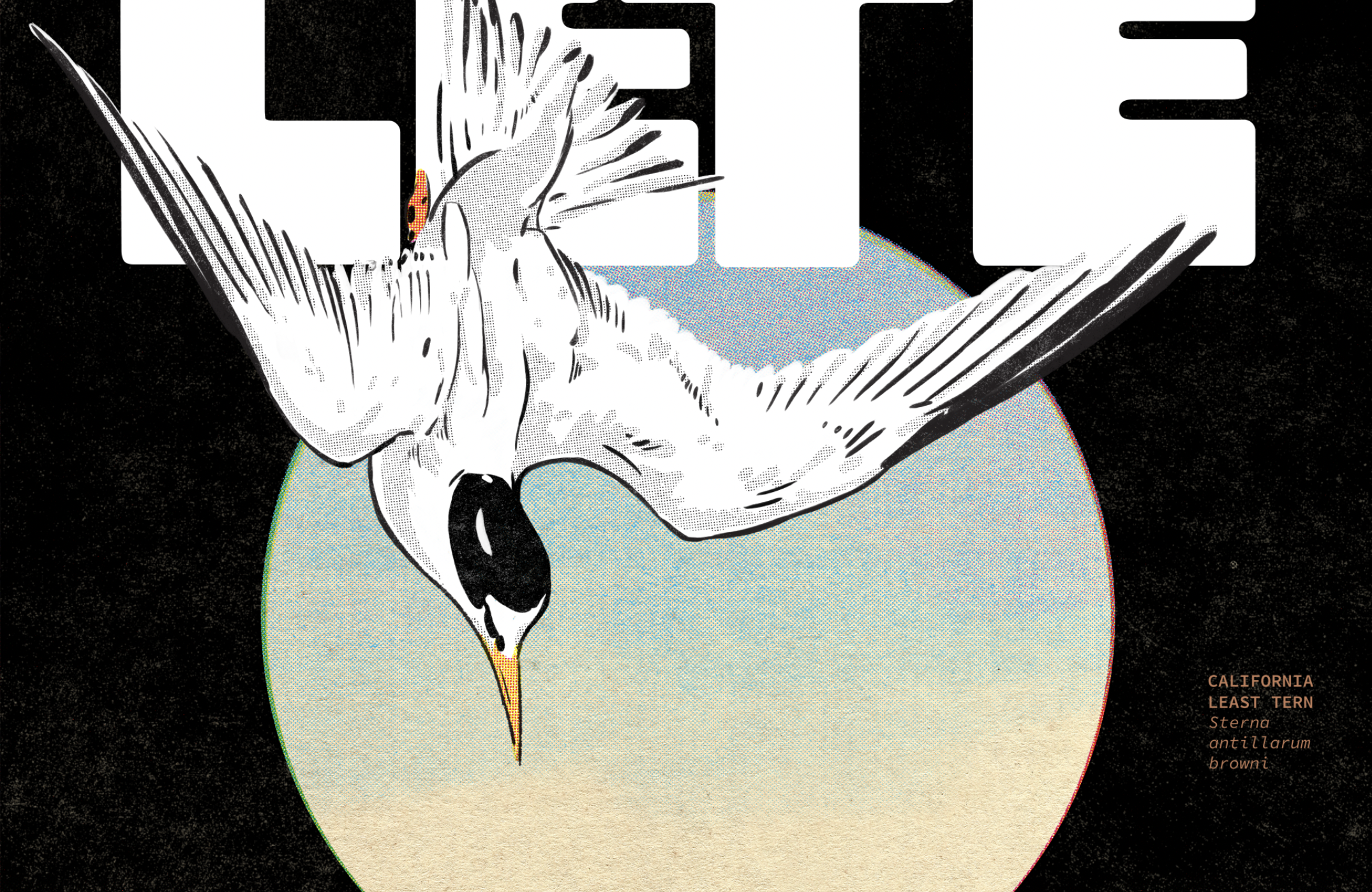
Every spring through summer, volunteers play a vital role in protecting the California Least Tern, the smallest tern species in North America and one of California's endangered coastal birds.
Breeding along the Pacific coast from San Pablo Bay, California, to San José del Cabo, Baja California Sur, Mexico, California Least Terns nest directly on open beaches and shorelines. This leaves their eggs and chicks especially vulnerable to predators, human disturbance, and habitat loss, making volunteer monitoring an essential part of the species' recovery.
We began volunteering with the San Francisco Bay Bird Observatory's (SFBBO) South Bay Tern Watch Program in 2024 at Eden Landing Ecological Reserve and have returned each nesting season since. After spending more than 40 hours monitoring the colony during our first season, we were inspired to explore how thoughtful design could support conservation. We created a series of posters and stickers to encourage more people to volunteer with SFBBO's South Bay Tern Watch Program.
WHY?
The idea for this poster began with a simple question. How could we help more people notice and care about the California Least Tern? The California Least Tern is an endangered species that many people have never heard of. We wanted to create something that would stop people in their tracks, invite them to learn more, and shine a light on the conservation effort happening every spring through summer.
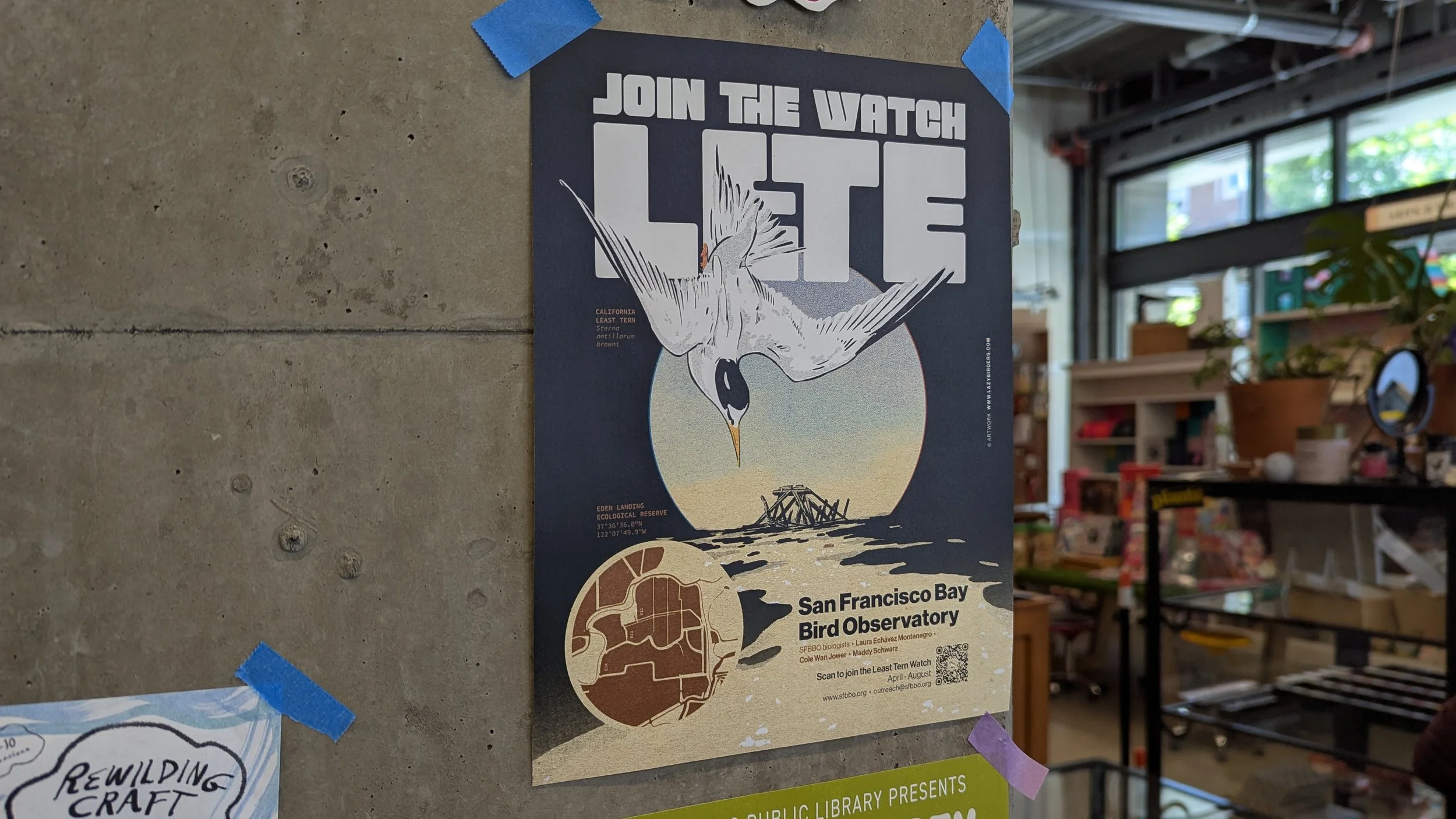
The poster was designed as a call to action, encouraging more people to join the San Francisco Bay Bird Observatory's South Bay Tern Watch Program.
The poster also became a way to preserve our own experience as volunteers at Eden Landing Ecological Reserve.
STYLE
To capture attention, we leaned into a vintage comic book aesthetic. Halftone dot textures, bold outlines, and vibrant colors give the poster an energetic, approachable feel while making the California Least Tern the hero of the story.
ELEMENETS
Scope. The circular composition represents the view through our spotting scope. For hours at a time, this was our window into the nesting colony as we searched for California Least Terns from a distance. By framing the illustration this way, we wanted viewers to experience the perspective of a volunteer and the patience that monitoring requires.
Archimedes Screw. At the center of the poster is the Archimedes Screw, a familiar landmark at Eden Landing Ecological Reserve that became our primary reference point while locating California Least Tern nesting sites on E14. Placing it at the heart of the composition grounds the poster in a real place and reflects how we navigated the colony from our distant vantage point. It also tells the story of the site's transformation from former salt ponds into important nesting habitat for California Least Terns and Snowy Plovers, demonstrating how restored landscapes can provide critical breeding habitat for endangered species.
Pickleweed Habitat. The spilled ink-like textures throughout the poster represent the pickleweed vegetation found across Eden Landing Ecological Reserve. This distinctive salt marsh plant is part of the landscape surrounding the California Least Tern nesting site and helps capture the unique character of the habitat where conservation work takes place.
Nesting Landscape. The open negative space leading toward the Archimedes Screw represents the expansive salt pond landscape where the California Least Terns nest. Scattered throughout this area are small white shapes representing oyster shells, which SFBBO volunteers spread across the nesting grounds each February. These shells help camouflage Least Tern eggs and chicks by breaking up their outline and making them less visible to predators.
Look closely, and you may also notice the small red terracotta pipe placed in the habitat. These shelters provide young terns with protection from predators, reflecting the many hands-on field efforts that support the colony throughout the breeding season.
Survey Site Map. The map in the lower left corner is based on our survey area at Eden Landing Ecological Reserve, highlighting the nesting sites we monitored across E12, E13, and E14. Beyond showing the location, the map represents the importance of place in conservation.
California Least Tern. The diving bird represents the California Least Tern, the inspiration behind this entire project. We chose an action pose to capture the energy and spirit of these small but resilient seabirds, from their fearless defense of nesting territories to their skillful dives while fishing. The dynamic movement also reinforces the poster's purpose as a call to action, encouraging more people to join SFBBO's South Bay Tern Watch Program and become part of the effort to protect this endangered species.
Text. The slogan ‘Join the Watch’ was chosen because it captures the experience of being a California Least Tern monitor: spending time in the field, observing the colony, and contributing to a larger conservation effort. While it carries a playful nod to Game of Thrones, the phrase reflects the commitment of volunteers who show up each season to help document and support the recovery of this endangered species
Scientific Details
The text elements on the poster incorporate the language used by birders and conservationists. LETE is the four-letter banding code or alpha code used to identify the California Least Tern in North and Central America, connecting the design to the field-based work of monitoring and documenting birds.
The scientific name, Sterna antillarum browni, adds another layer of detail by highlighting the species' classification: the genus Sterna, species antillarum, and subspecies browni. Including these scientific references reflects the research and observation that are at the heart of bird conservation.
TOOLS USED
Every tool played a role in translating our field experience into the final poster.
Sketchbook: Every element began on paper. Vinish explored different compositions and visual ideas using pencil and pen before moving into a digital workflow.
Camera(Sony Alpha 7 II + phone): Photographs taken during our volunteer surveys were used to study the California Least Tern's anatomy, behavior, and habitat, providing reference material for the illustrations.
Adobe Photoshop: The primary application used to illustrate and design the poster.
Wacom Tablet: Used for digital illustration and inking.
Custom Photoshop Brushes: Texture brushes and halftone dot effects helped recreate the look of vintage comic books.
Textured Paper Overlay: A digital mildew textured paper look added subtle wear and character, completing the classic comic book aesthetic.
COLOR PALETTE
The color palette was inspired by both the California Least Tern and the look of vintage printed comic books.
We worked primarily in CMYK, embracing the slight overlaps and halftone dots that give old printed posters their distinctive character. The core palette of black, white, and gray reflects the plumage of the California Least Tern, while yellow draws attention to the bird's most recognizable feature, its bright bill, making it the focal color of the composition.
A blue gradient provides contrast and depth while echoing the open skies over Eden Landing Ecological Reserve, where we spent our time monitoring the colony. Finally, brown was reserved for the map and informational elements, giving them a neutral, archival feel without competing with the illustration
FONTS/TYPOGRAPHY
The typography balances impact with clarity, helping guide the viewer through the poster.
Title. Hisyam: A bold, heavy display font chosen to immediately capture attention while conveying the importance of the conservation message.
Body Text. Neue Haas Grotesk Display: A clean, modern sans serif selected for its clarity and readability, ensuring the supporting information remains accessible.
Scientific Details. Source Code Pro: A monospaced typeface used for the scientific name and map coordinates, adding a subtle field-note aesthetic that reflects the scientific and data-driven nature of the monitoring program.
FINAL PRINT
The poster was designed with distribution in mind, making it easy for SFBBO to display and share with the community.
Paper: Matte finish to reduce glare and improve readability.
Size: 8 × 11 inches, making it easy to pin on community notice boards, library bulletin boards, visitor centers, and other public spaces.
Print Run: 100 copies donated to the San Francisco Bay Bird Observatory (SFBBO) to support volunteer recruitment for future South Bay Tern Watch seasons.
LEARN MORE ABOUT THE PROGRAM
Protecting the California Least Tern is a collaborative effort that spans the state's coastline, bringing stakeholders together to safeguard nesting colonies and monitor breeding success. In the San Francisco Bay, the San Francisco Bay Bird Observatory (SFBBO) coordinates volunteer monitoring at the California Least Tern colony in Eden Landing Ecological Reserve through its South Bay Tern Watch program. Volunteers spend time observing the colony, recording nesting activity, and reporting predators to SFBBO biologists (Lao, n.d.). These efforts provide critical data on breeding success while helping conservation teams respond to threats, making volunteers an essential part of the California Least Tern's recovery (Lao, n.d.).
ACKNOWLEDGEMENTS
Field trip SFBBO led by Sirena Lao 2023
Arun and Rajani, LETE Monitors 2023, who told us more about the program
Maddy, Cole, and Laura from SFBBO → Conducted online and field trainings
Everyone we have car-pooled with at Eden Landing Reserve
REFERENCES
California Least Tern (Sterna antillarum browni) | U.S. Fish & Wildlife Service. (n.d.). U.S. Fish and Wildlife Service. Retrieved July 16, 2026, from https://www.fws.gov/species/california-least-tern-sterna-antillarum-browni
Lao, S. (n.d.). Least Tern Monitoring Program. San Francisco Bay Bird Observatory. Retrieved July 16, 2026, from https://www.sfbbo.org/letemonitoring.html